
7 Modern Lessons From Tarzan
On Manliness, Dating, and being Yourself


I recently watched the Tarzan animated series and did something I don’t usually do — I went and read the original book series it was based on.
It took a bit of adjusting, but I got hooked fast, and this week I finished the last book. I’d read all 24 of Edgar Rice Burroughs’ Tarzan books.
While it’s still fresh in my memory, here are 7 lessons we can still learn from the ape-man:
1. You Can Master Anything
Tarzan first learned the way of the apes as a baby, in the harsh jungles of Africa. Mastery of his environment wasn’t optional — it was the only path to survival.
none of them could understand how a child could be so (small) and backward in learning to care for itself.”
― Edgar Rice Burroughs, Tarzan of the Apes
As an adult, he had to learn everything all over again — how to be human this time. How to socialize, how to speak English, French, several African dialects. Later, how to fly a plane, how to be a husband, a father.
If Tarzan hadn’t been open to learning, he wouldn’t have survived to adulthood among the apes. And if he’d stopped there, at only ape knowledge, he’d never have made it into human society at all. Learning kept him alive, made him friends, got him a wife and his family inheritance — not to mention one hell of an adventure.

2. It Starts With Mastering Yourself
Growing up among the apes, Tarzan never looked to anyone else to save him. Animals have to become independent a lot faster than humans do, and Tarzan was no exception.
Watching what the dominant apes could do, he set that as his own milestone. Nobody told him he was human and therefore couldn’t compete with a gorilla’s raw power — so he never accepted the limit. He pushed himself until his strength was almost superhuman.
“It had become evident to Tarzan that without money one must die. D’Arnot had told him not to worry, since he had more than enough for both, but the ape-man was learning many things and one of them was that people looked down upon one who accepted money from another without giving something of equal value in exchange”
― Edgar Rice Burroughs, Tarzan of the Apes
But that didn’t happen by accident. From the beginning, he set his mind on becoming a powerful ape. And he became one — eventually leading his ape family.
Set a goal. Fail as many times as it takes to reach it. Then set the next one.
3. The Right Thing Is Mostly Clear, Never Easy
Tarzan almost always tried to do the right thing, even when it wasn’t easy — even when it meant risking his life. He put the people he was protecting above himself, again and again.
Maybe if he’d been raised by wild cats, he’d have grown up solitary. But gorillas are social animals that look after the herd, and as an alpha male, protecting the group is the job. Tarzan carried that instinct with him into human company — protecting total strangers just as fiercely as he’d protect his own troop.
Life viewed through this lens meant that he always knew what the right thing to do was, and he did it no matter how difficult.
4. Be Brave
Growing up in the jungle taught Tarzan that half the battle is standing your ground and showing no fear. Among rival gorillas, bluffing is a core part of the fighting strategy — you charge, and whoever runs loses automatically.
Same with big cats: running triggers a predator’s chase instinct even when it had no real interest in you a second earlier. (If you’ve ever dragged a string in front of a cat, you’ve seen this in action.)
So Tarzan learned to be fearless. But “fearless” for him didn’t mean reckless — every action, including retreat, was led by strategy rather than raw emotion.
How many times in our own lives have we hit some obstacle that felt insurmountable, like the end of the road? Tarzan’s answer would be: don’t let emotion drive your action. Relax, think strategically, and decide — attack or evade — based on what actually serves you.
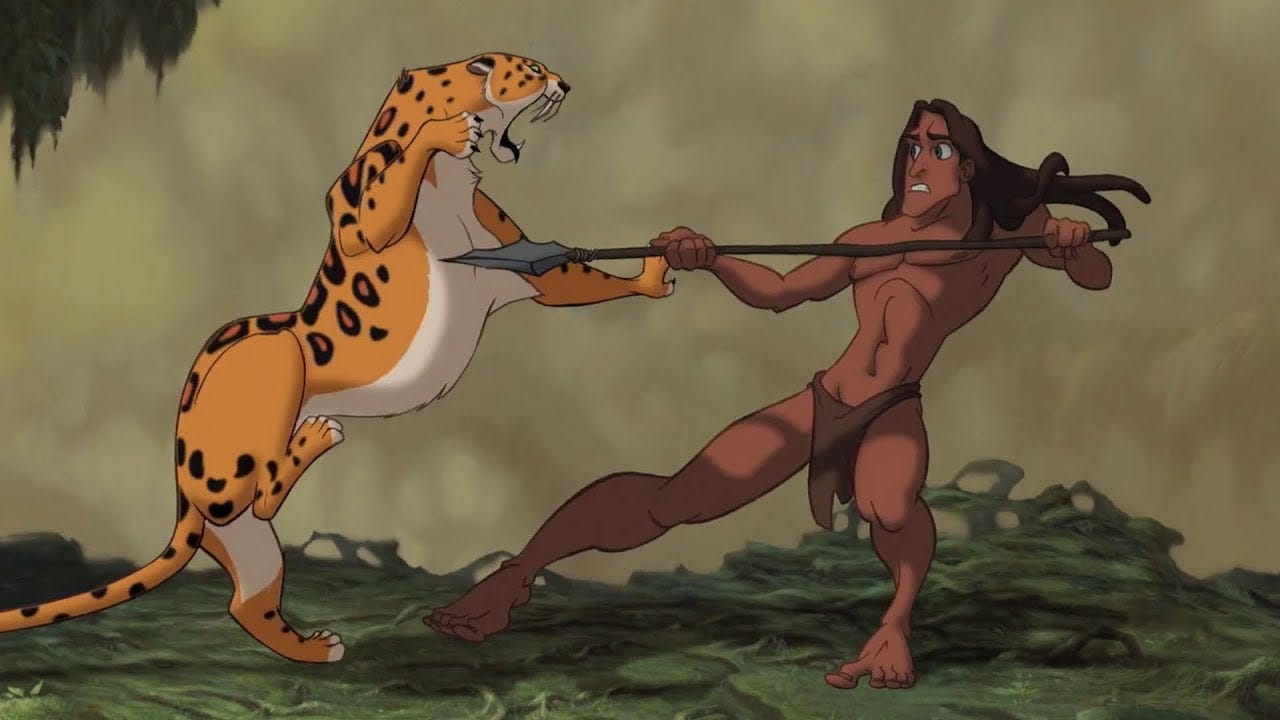
There’s a real difference between self-confidence and overconfidence, and Tarzan walked that line carefully. He was never one to put himself in needless danger, but he’d always act decisively when he had the upper hand, and retreat cleanly when he was clearly outmatched. There’s always another way. Another day.
5. Life Is the Greatest Gift
Animals, outside of rare circumstances, don’t commit suicide. They don’t really get depressed either. Growing up among apes, Tarzan absorbed this beneficial psychology.
Plenty of times in the books, he’s on his proverbial last straw — on the verge of death in situations where most people would resign themselves to fate under the mental weight of certain doom. But Tarzan is always moving forward. Always buying himself one more minute of life.
There’s a scene in Tarzan the Untamed — the seventh book in the series — that captures this perfectly.
Tarzan crosses a desert alone, half-dead from thirst and exhaustion, trying to reach his old ape tribe. A vulture circles him, waiting for him to give up. Tarzan falls, and the bird moves closer, just enough for him to grab it. Tarzan drinks the blood of this vulture to survive, buying himself extra time to escape the desert.
Bet you didn’t see that one in the Disney movie ; )
Every second is a gift. Depression, sadness, anything that saps your forward momentum, is of no use to you. Like Tarzan — you just have to keep moving, and watch out for your path to salvation. It might come in the most unexpected form.
6. Self-Contentment Is Sexy
Tarzan was happily married, and yet almost every single woman he crossed paths with fell for him. Raised by apes, he somehow turned out to be a natural ladies’ man.
But he wasn’t using pickup lines. He wasn’t showing off a Lambo on his Tinder profile — the man wore a loincloth through most of his adventures. By modern dating standards, Tarzan was severely lacking materially.
What he did have, however, was the mentality of a high-value man. He showed rather than bragged about what he could do. Even his physical form, a model of peak athleticism, spoke for itself — a man who prized action over words.
He never asked anything in return for what he did, and never expected anything from anyone. If Tarzan wanted to do something, he did it. If he didn’t want to do something, then nothing and no one could make him.
While other male amateurs were confessing their feelings to the women from a place of weakness, Tarzan carried the self-assurance of someone who already had everything he needed. A woman could add to his life, but he was self-content even in solitude. He did nothing to make you like him or date him — he was simply himself.

I think most women would agree that their ideal man is someone both resourceful and generous. Because if you’re generous with nothing to offer, it’s meaningless. But resourceful and stingy is socially useless.
Tarzan struck a healthy balance of both — which is exactly what made women want to rip that loincloth off him.
7. Love Yourself — No One Is Above or Below You
The Tarzan series isn’t perfect. Edgar Rice Burroughs was very much a product of his time, and the books’ racial politics haven’t aged well.
But there’s one thing Burroughs understood clearly: self-pride sits at the top of the pyramid when it comes to living a happy, productive life.
He continually wrote about the majesty of the lion, the cheetah, the monkey — each animal carrying an almost total confidence in its own importance within its sphere of life.
Beyond food, rest, and a mate, most animals don’t have much more to want from life. It’s the human mind that always craves excess.
Which is probably why so many of us deal with depression or anxiety — we’re raised in an environment where simply being yourself is never treated as enough. There’s always something more you can become: richer, smarter, better-looking.
Fall short, and you’re a “loser.”
It’s also why Tarzan could never stay long in the “civilized” world. Always he thought of returning to his jungle. The people of the city wanted him to be more like them — to trade his loincloth for a suit, his penniless existence for a job. They wanted him to be like them, to focus on amassing more wealth than he could ever spend, instead of living day to day as he did.

But Tarzan saw that they had all those things, and they were still unhappy. He saw that wealth only made people want more wealth. This human greed sickened him and is why he only found peace in the jungle.
Among the animals, no one is judged on imaginary social possessions. Hierarchy among the gorillas came down to who could fight best for and protect the tribe. Unlike human society, where people can become powerful by being shadier and by even hurting the tribe.
So Tarzan stopped taking the critics of “civilized” society seriously. People who were themselves unhappy and contradictory had no business lecturing him on how to live.
Tarzan kept his loincloth, kept swinging through the trees, and kept living life on his own terms.
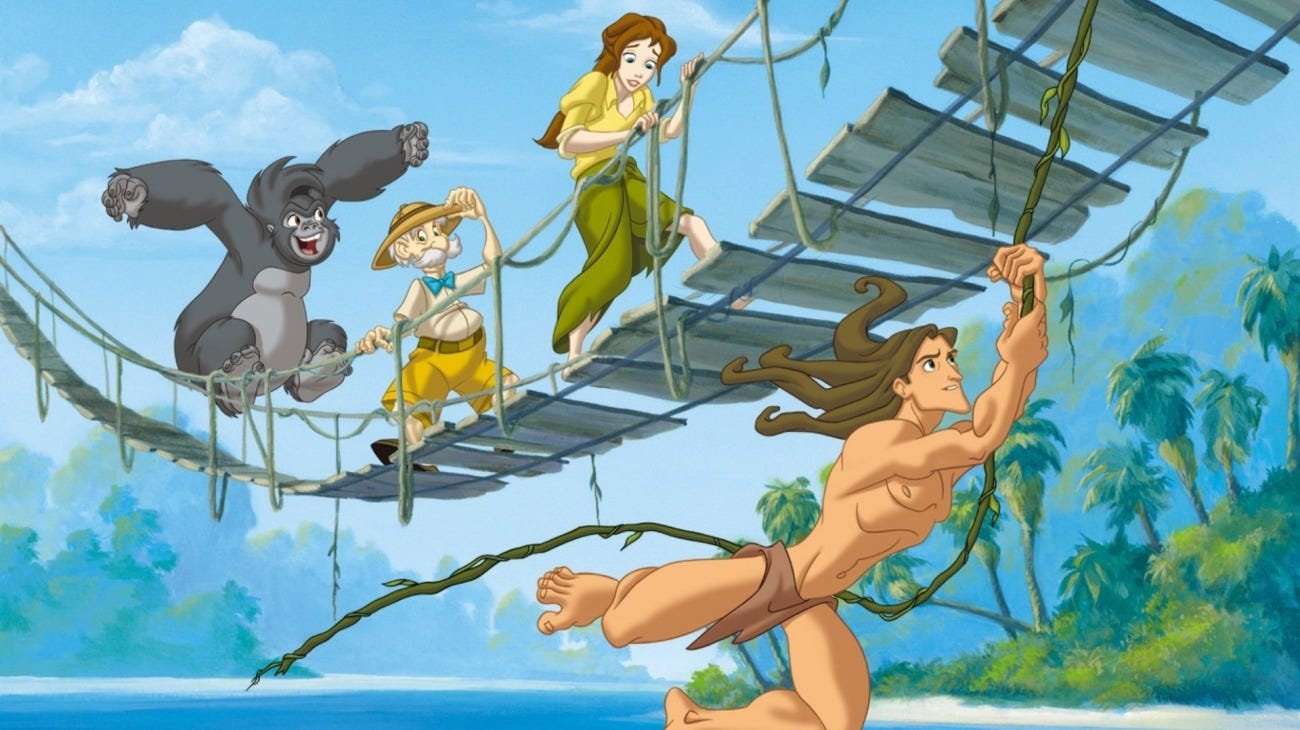
The lesson here is that we’re all different, all unique in our own way. Wherever you are, whoever you are, no matter what people think of you — have a high opinion of yourself.
If and when you do decide to change, make sure it’s something you actually want, something that moves you closer to your goals and a better version of you — not someone else’s checklist.
Closing Notes
The Tarzan series is over a hundred years old now, and it still captures the global imagination. There’s a lot left in the undying ape-man worth learning from.
Long live Tarzan.
RIP Edgar Rice Burroughs.